*This post MAY contain affiliate links. That means that if you make a purchase after clicking on a link I may earn a small commission at no extra cost to you. I don’t ever recommend something that I don’t use myself. Not all links are affiliate links. For more information, see our Privacy Policy.
To print this page, click the green Print button below the article. If that doesn’t work, try Ctrl + P (or Flower + P) to bring up the printer dialog box.
Choosing the Right Thread for your project
(and your machine)
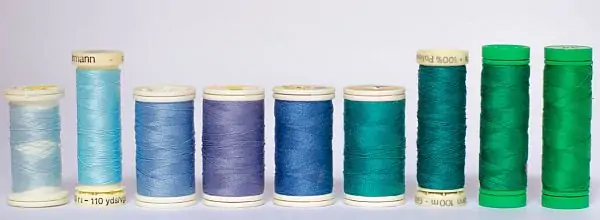
Choose the right thread. There are so many different types of thread available! How do you know which one is right for your project? Start with the reason you will be using this thread and go from there.
The latest quilt trend is in Fiber Arts, the art of embellishing a textile with various fibers to create a work of art. Fiber Art can take many forms and use a myriad of materials especially created for the artist. This article is about Threads, both specialty threads for embellishment and regular, average, every day thread.

blog tutorial here.
Generally, a 20 – 30 wt thread is used for a heavy thread used for decorative stitches. 28 wt. or 30 wt. thread is used for in the bobbin for decorative work. 40wt thread is a quilting thread and 50 wt is a piecing thread. 50wt and 60wt can be used in the bobbin and is also good for appliqué. This is only a rough guideline, however, rules are made to be broken! Experiment with what works best for you.
To help you with your selection, read the end of the spool. Generally, you will find information about:
- The manufacturer and brand of the thread
- The color number
- Its weight and the number of plies (strands) that are twisted together. This is usually referred to by a number that looks like a fraction. For example, if you see the number 60/2 that means that the thread is a 60 weight 2 ply thread. The higher the first number, the finer the thread.
- The fiber content
- Whether or not the thread is mercerized
- and maybe even the country of origin.
What is mercerized thread?
Simply put, mercerized cotton thread has been put through a series of processes causing the thread to swell, become round and straighten out. Any fuzz is singed off. This increases the luster of the thread as well as improves water and dye absorption. Since fine, long stapled fibers respond best to mercerization, it is usually those types of cotton (Sea Island, Egyptian, Pima) that are used. Most threads currently manufactured are mercerized.
When using your thread on a machine, be sure to put the top part of the spool up. This isn’t always as obvious as you might think. To determine which part of the spool is the top, hold the spool horizontally by the top and bottom. Unroll about a foot of the thread. If the thread hangs freely, you unrolled it from the top. If it twists back on itself, you unrolled it from the bottom.
Don’t use old thread you find laying around just to use it up. Give it the yank test. If you can break it by yanking it off the spool, it will break in your machine. Toss it out. Do not save it for a craft project, throw it out for the birds (which can be fatal to them) or donate it to charity. Put it in the garbage can and don’t look back.
The correct needle for specialty threads
If you are hand stitching, the sharp edges of the needles eye may fray the thread. To help prevent this, thread the needle with a short (less than 18″) length of thread, then slip the thread back thorough the eye again forming a loop around the eye. Every few stitches, tug at this loop to get the tail to slip about another inch along its length so the same piece of thread isn’t going through the needle’s eye.
- When threading your hand needle, remember to knot the end that you cut off the spool to keep tangling at bay. Here’s a mnemonic for you: Remember, the end you Kut is the end you Knot.
- When machine quilting, use the appropriate needle. For example, the Metallic Thread Needle is designed for the use of monofilament/nylon, metallic, and other decorative threads. It has a larger eye and long groove (scarf) which accommodates the heavier thread and makes threading easier as well as helping to prevent the shredding, splitting and breaking threads during stitch formation.
- For a detailed explanation of sewing machine needle types and recommendations, click here.
- Here is a buying guide for sewing machine needles from JoAnns.
Sewing with specialty threads
If you are sewing with specialty threads you will most likely have to adjust needle and tension positions. Remember to always adjust the upper tension of your machine with the foot down. It may not register the change if it is up. Once you find a setting you like, write it down! Then play with the tensions to see the different effects that you can achieve by “pulling” the bottom thread up to the top.
Many threads really perform better in the bobbin with a cotton or invisible thread in the needle. If you like the effect, consider buying a separate bobbin case and leaving the tension set up for bobbin work. The diagram below was provided by Superior Threads.

Problems with fancy thread?
Try these suggestions and see if it helps.
- Slow down. Speed and fancy thread don’t mix.
- Rethread your machine. Experiment with not putting the thread through the thread guide that is just at the top of the needle.
- Change the needle. Are you using the proper size? A too small needle will shred medium and heavy threads.
- Lower your tension. When the top thread loops on the bottom, the tension is too loose
- Try another brand of thread.
Thread for Machine Embroidery
If you are going to be embroidering with your machine, choose your thread weight according to the design. Embroidery thread is available in sizes ranging from 30wt (heavier thread good for lots of fill) to 60wt (thinner thread for more detail.) Embroidery thread can be rayon, polyester, cotton, or silk.
- Rayon makes very shiny embroidery threads that are readily available in many colors. However, they are not always colorfast. Make a test piece to check for shrinking and color fading. Before purchasing your thread, check the end of the spool for the country of origin. Do not buy it unless it was made in the USA. Thread made in other countries has been shown to have high acid content which causes rapid thread deterioration, unstable colors, uncontrollable thread breakage, and rapid thread deterioration. To prolong the life of your rayon thread, keep it in the freezer. Be sure to bring the thread to room temperature before sewing.
- Nylon (polyamide) thread will melt and fuse at a low temperature. Nylon thread goes brittle, yellows over time, and melts at low temperatures. Unfortunately, most invisible monofilament thread is nylon.
- Polyester monofilament invisible thread does not go brittle, or yellow over time or melt at low temperature. Polyester embroidery threads are made of long stapled fibers with a silk like finish which are them durable and color fast. They will not shrink or stretch so your embroidery motifs will not distort over time.
- Cotton thread is available in weights from 30 to 60, and is usually a long staple thread with a high luster finish. It is most appropriate for embroidery on heirloom sewing, quilt embroidery, religious garments and altar adornments. The longer the staple thread, the better quality it is. If the thread doesn’t say, assume it to be short stable.
- Metal/Plastic combination threads provide intensely shiny and colorful embellishments. They aren’t actually threads. They are made from thermoplastic with an aluminum coating which are then cut into thin strips with a laser and wound. It must be completely unwound to be used because of static cling. It must be sewn with a metallic needle.
- Metallic thread is made from aluminum-coated core thread which can be cotton, poly-cotton, polyester, or paper. Easier to use than the metal/plastic combination thread, it also should be unwound before it is sewn using a metallic needle. To prolong the life of your metallic thread, keep it in the freezer. Be sure to bring the thread to room temperature before sewing. If you have a lot of trouble sewing with metallic thread, loosen the top tension and/or use a thinner thread in the bobbin. Make sure you are using the needle recommended by the manufacturer. It may be necessary to load the thread in the bobbin and quilt upside down.
Part Two: Threads and Their Uses
The second part of this article lists threads that are available today, their characteristics and recommendations for usage. Go on to part two.